



A funding deadline in 2032 could trigger a 20% cut in benefits unless Congress acts. The senators elected this year will be in office when that moment arrives.
Voters focused on gas prices, health care, and foreign policy may be overlooking a slower-moving financial crisis: Social Security. The program that tens of millions of Americans depend on is heading toward a funding shortfall — and the senators winning seats right now will be the ones in Washington when Congress is forced to decide what to do.
From debates in Michigan to candidate forums in Maine, the issue is already reshaping how campaigns talk about retirement security. Here's what the deadline means, what's on the table, and what it could mean for your benefits.
- 2032 — Social Security Funding Deadline
- 20% — Potential Benefit Cut
- 6 yrs — Senate Term Length
The math is straightforward — and the consequences are not. Under current law, Social Security's funding is projected to hit a wall in 2032. When that happens, the program would only be able to pay out what it takes in, resulting in an automatic 20% cut to every beneficiary's check unless Congress steps in first. That includes people already retired, people on disability, and survivors who depend on the program.
The senators Americans vote into office this year will serve six-year terms — putting them squarely in Washington when that deadline arrives. That means the choices voters make now aren't just about the next budget cycle. They're about who sits at the table when Congress is eventually forced to act.
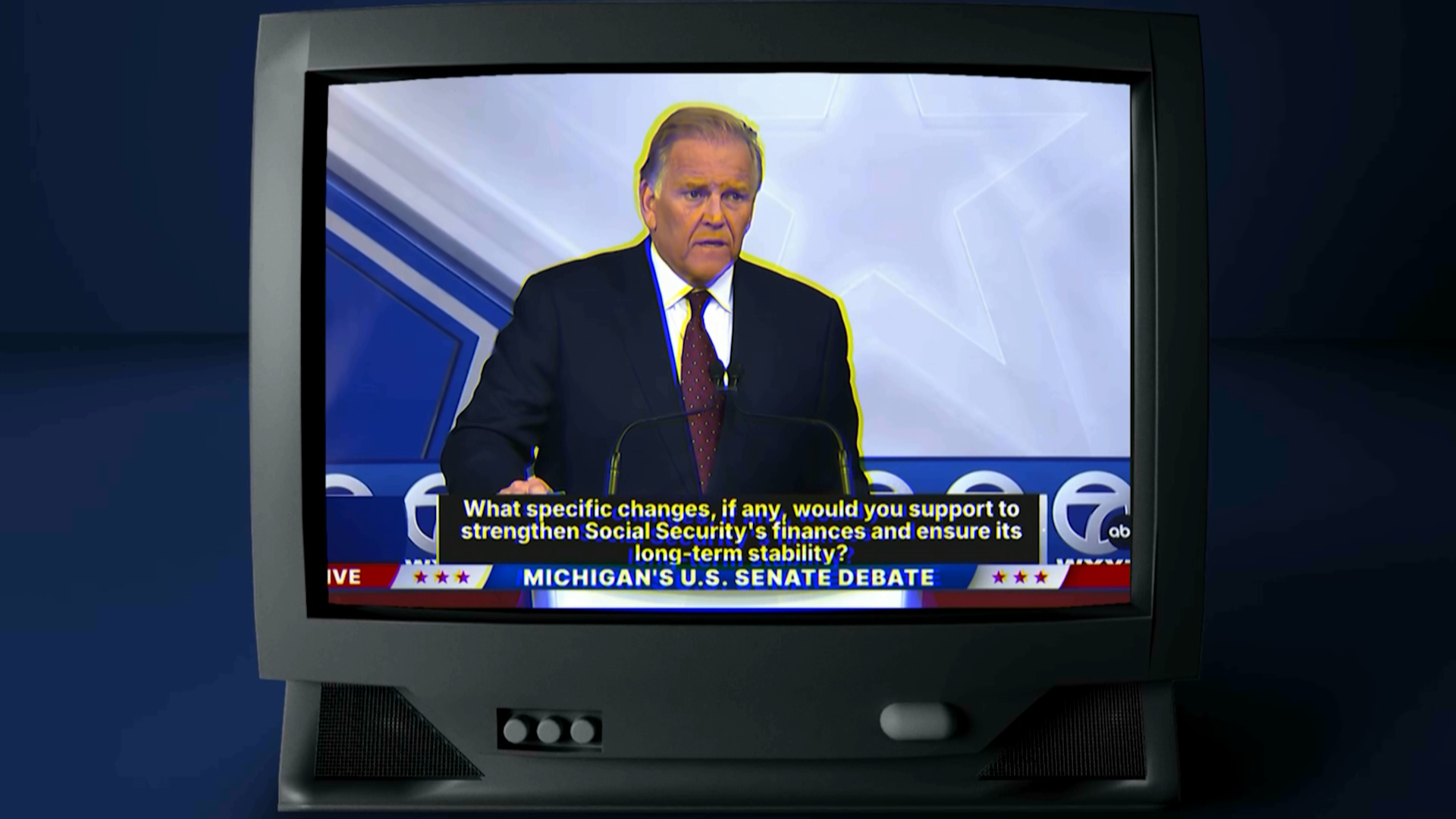
I dont think a lot of people know by law there would be a cut in 2032Mike Rogers, Republican nominee for Senate in Michigan
That acknowledgment from a Republican Senate candidate in Michigan reflects just how quickly Social Security has moved from political third rail to campaign centerpiece. From Scripps News Group's debate stage in Detroit to candidate forums in Maine, the program's finances are being debated openly — and candidates are being pressed on what they'd actually do.
Michigan's Democratic nominee Abdul El-Sayed has proposed eliminating the income cap on Social Security taxes entirely. Maine's Sen. Susan Collins has called for a bipartisan commission to study solutions. The distance between those two approaches captures the difficulty Congress will face: the solutions that exist are politically costly, and the window to act is narrowing.
Three Approaches to Social Security's Funding Gap
| Raise the Tax Cap | Raise Retirement Age | Bipartisan Commission | |
|---|---|---|---|
| Core Mechanism | Tax more income above $184,500 | Require longer work before full benefits | Defer decision to expert panel |
| Public Support | Over 80% support | Contested | Varies by proposal |
| Current Retirement Age | 67 | Would rise | 67 (status quo pending) |
| Who Bears the Cost | High-income earners | Future retirees | Determined later |
| Backed By | Abdul El-Sayed (MI-D), Martin O'Malley | Some congressional Republicans | Susan Collins (ME-R) |
If Congress doesnt act, then every current beneficiary [could] receive a 20% reduction in benefitsMartin O'Malley, former Social Security Commissioner
How Well Do You Know the Social Security Deadline?
Four questions. The answers may surprise you.
Under current law, what would automatically happen to Social Security benefits if Congress takes no action by 2032?
- Benefits would be frozen at current levels — Not quite. A freeze would actually be better than what the law currently prescribes. Without congressional action, benefits would be cut — not frozen — by approximately 20% for every beneficiary.
- Every beneficiary would face a roughly 20% cut — Correct. Former Social Security Commissioner Martin O'Malley put it plainly: if Congress doesn't act, every current beneficiary could receive a 20% reduction in benefits. That's the automatic consequence written into current law.
- Only new retirees after 2032 would be affected — The deadline applies to all beneficiaries — current retirees, people on disability, and survivors — not just those who retire after 2032.
- Social Security would shut down entirely — The program wouldn't shut down — it would still pay out what it collects. But that amount is projected to cover only about 80% of promised benefits, creating the 20% cut.
At what income level do Social Security taxes currently stop being collected?
- $100,000 — The actual cap is considerably higher. Earnings above $184,500 are not subject to Social Security taxes — meaning the highest-earning Americans pay the same dollar ceiling as those earning just above the cap.
- $250,000 — The cap is actually lower than that. The first $184,500 in annual earnings is taxed for Social Security; anything above that threshold is exempt under current law.
- $184,500 — Correct. The current income cap is $184,500. One leading fix would eliminate or alter that cap, subjecting more of high earners' income to Social Security taxes — a change that polls show more than 80% of Americans support.
- There is no cap — all income is taxed — There is a cap, and it sits at $184,500. Income above that amount is currently exempt. Removing or raising that cap is one of the most-discussed solutions to the funding gap.
The last time Congress faced a serious Social Security funding crisis, how close to the deadline did lawmakers wait before reaching a deal?
- Several years before the deadline — History tells a different story. When Congress confronted significant Social Security cuts in the 1980s, lawmakers did not reach an agreement until the deadline was just months away.
- About two years out — Even closer than that. The last time Congress dealt with a Social Security funding crisis — in the 1980s — a deal wasn't struck until the deadline was just months away, suggesting urgency alone doesn't speed up negotiations.
- Just months before the deadline — Correct. In the 1980s, the last time Congress confronted significant Social Security cuts, a deal didn't come together until the deadline was just months away. That historical pattern is part of why experts are watching the 2032 clock closely.
- After missing the deadline entirely — Congress did act before the deadline in the 1980s — but barely. A deal came together only when the deadline was just months away, a pattern that observers worry could repeat itself leading up to 2032.
A Trump administration report cited which combination of factors as contributing to fewer dollars flowing into Social Security?
- Aging baby boomers and longer life expectancies — Those are commonly cited long-term pressures, but the Trump administration's report specifically pointed to lower fertility rates, higher deportations, and tax changes as contributors to the shortfall.
- Lower fertility rates, higher deportations, and tax changes — Correct. A Trump administration report found that lower fertility rates, higher deportations, and tax changes have contributed to fewer dollars flowing into Social Security — an acknowledgment that policy decisions have compounded the program's financial pressures.
- Rising health care costs and Medicare overlap — Those factors affect federal budgets broadly, but the Trump administration's report specifically identified lower fertility rates, higher deportations, and tax changes as the contributors to Social Security's shrinking revenue base.
- Increased fraud and improper payments — The Trump administration's report did not cite fraud as a key driver. Instead, it pointed to lower fertility rates, higher deportations, and tax changes as factors reducing the dollars flowing into the program.
That's exactly the kind of knowledge gap the 2032 deadline is closing — fast. The program hasn't faced a moment like this since the 1980s, when Congress waited until the deadline was months away before reaching a deal. History suggests urgency alone doesn't accelerate negotiations in Washington.
The political difficulty is real on every proposed fix. Raising the tax cap on incomes above $184,500 would function as a tax increase on higher earners — something many Republicans have resisted. Raising the retirement age above 67 shifts the burden onto workers, particularly those in physically demanding jobs who can't easily work longer. A commission, as Sen. Collins has proposed, delays the hard choices — potentially past the deadline.
You would find that solution is supported by over 80% of people, and that is where I actually think where the art of the compromise is going to be found.Martin O'Malley, former Social Security Commissioner
Common Claims About Social Security — Checked
Social Security is going bankrupt in 2032.
Verdict: mostly false
The program isn't going bankrupt — it would still collect payroll taxes and pay out benefits. But the funding shortfall means it could only cover roughly 80% of promised benefits, resulting in an automatic 20% cut, not a total collapse.
Only future retirees would be affected by the 2032 shortfall.
Verdict: false
Former Social Security Commissioner Martin O'Malley was explicit: every current beneficiary could face a 20% reduction in benefits if Congress doesn't act. The cut applies across the board — retirees, disabled recipients, and survivors.
Raising the income tax cap has broad public support.
Verdict: true
O'Malley cited polling showing that eliminating or altering the Social Security tax cap is supported by over 80% of people — making it one of the rare proposals with genuine cross-partisan backing.
Congress has never solved a Social Security crisis before.
Verdict: false
The 1980s presented a similar moment, and Congress ultimately reached a deal — though not until the deadline was just months away. That precedent cuts both ways: a fix is possible, but it may not come early.
What a Trump Administration Report Found
A report from the Trump administration found that lower fertility rates, higher deportations, and tax changes have contributed to fewer dollars flowing into Social Security. The finding is notable because it ties specific policy decisions — not just demographic trends — to the program's funding pressures.
Lower fertility rates mean fewer workers entering the system over time. Higher deportations reduce the number of workers contributing payroll taxes. And tax changes can shift how income is classified, affecting how much revenue flows to the program. Together, these factors compound the structural funding gap that Congress will eventually need to address.
Dig Deeper Into Social Security's Future
- Interactive: Could Your Check Shrink by 2032?: Scripps News built a calculator showing how the funding shortfall could affect millions of Americans. See the numbers for yourself.
- The Full Funding Problem Explained: Scripps News reporting on what the funding gap means, who it affects, and what Congress would have to do to fix it.
Social Security matters to every corner of America because it is one of the few federal programs that touches nearly every household — whether through a grandparent's retirement check, a disabled family member's monthly benefit, or a worker's paycheck deductions that fund it all. The senators elected now won't just inherit an abstract policy debate. They'll inherit a deadline with a specific date and a specific consequence: a 20% cut to benefits that tens of millions of Americans are counting on.
The 1980s showed that Congress can act — but also that it tends to wait until the last possible moment. With the 2032 deadline now within a single Senate term, the voters who cast ballots this year are, in a very real sense, choosing who will be in the room when the deal gets made — or doesn't.
