



BOZEMAN — Many people likely remember this past summer, when wildfire smoke filled the air. Now, researchers at Montana State University are studying air pollutants such as wildfire smoke with funding from NASA.
WATCH STORY HERE:
Gabe Sova is a senior at Montana State majoring in mechanical engineering.
“It’s definitely challenging, which everyone told me going into it, which I didn’t believe them. They’re right,” Sova said.
Since 2024, Sova has been part of an MSU research lab funded by NASA, and it all started with a simple walk past an office. After spotting the NASA logo, Sova and a friend decided they wanted to learn more.
“Me and a friend camped out in front of the offices, and we went in and were like, ‘So, what’s NASA? How do we get involved with that?’” Sova said.
That’s when Sova was pointed in the direction of Dr. Mike Walach, an associate professor in the College of Agriculture.
Sova was welcomed to Montana State’s BOREALIS Lab, and no, they don’t study the northern lights.
“With NASA, you have to have a silly acronym. So BOREALIS is the Balloon Outreach, Research, Exploration and Landscape Imaging System,” Walach said.
The lab’s research focuses on high-altitude balloons and drones used to capture images. Its most recent project comes with another acronym: the Aerial Science, Collaboration, and Education Network for Discovery, or ASCEND project.
“We are looking at air quality across the United States,” Walach said.
The start date for the $3 million NASA grant was Oct. 15. Researchers have been working to create American-made drone kits.
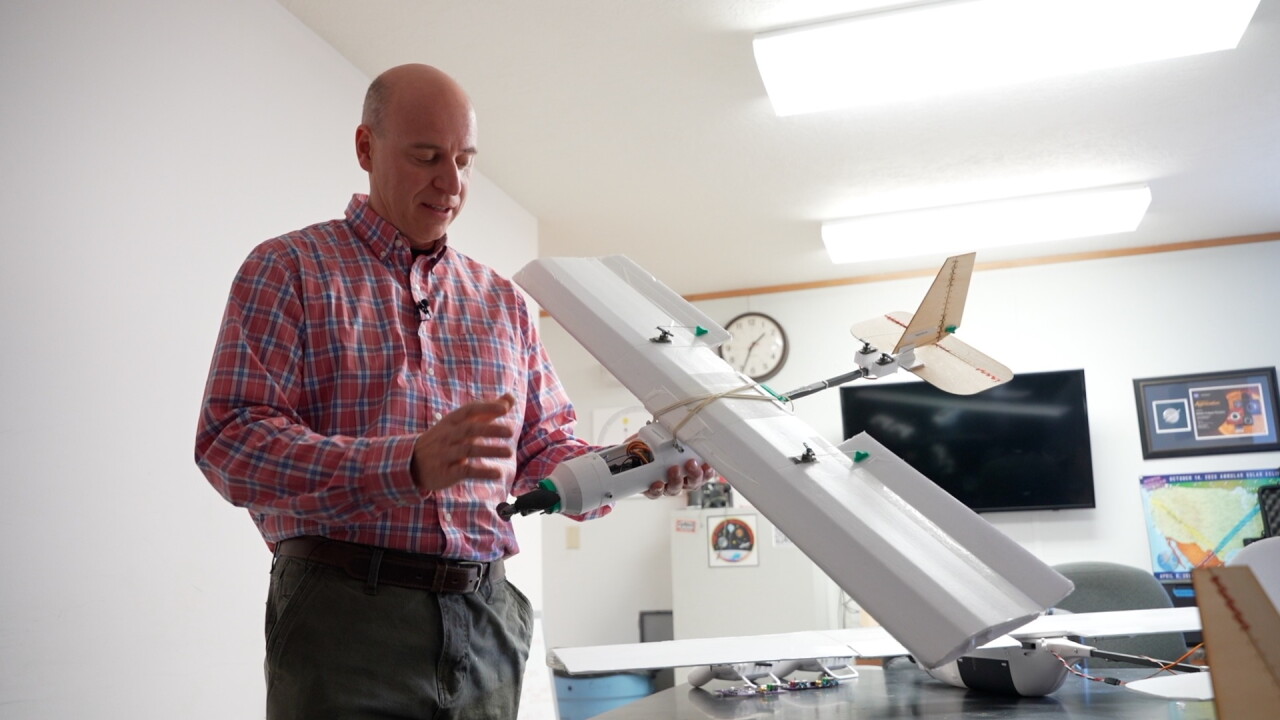
“This is an airplane that’s fully autonomous that we’ve developed here in the lab. The whole thing is 3D printed,” Walach said while showing one of the drone planes.
The kits will be sent to 40 undergraduate teams at community colleges across the country to gather samples.
“Measuring the vertical column of pollution. We’re really interested in wildfire smoke movement, but we’re measuring all pollutants,” Walach said.
The research could be particularly important when it comes to understanding wildfire smoke.
“What we’re seeing in the last couple of years is that the wildfire smoke is being pushed up into the stratosphere. They’re burning hotter and more intense than they ever have before,” Walach said. “That’s concerning because it doesn’t get purged out of the atmosphere like it normally would if it just sits in the troposphere.”
The goal of the NASA-funded air pollution research?
“We’re interested to see how widely dispersed that is. Really trying to get a good understanding of what the problem is,” Walach said. “Before you make any attempt to try and solve it, you really have to understand where you are.”
For Sova, it’s important work that he’s excited to spend as much time on as he can.
“It’s really cool to be a part of something. But then it also is a little sour because I’m like, ‘I’m leaving right when this is picking up,’” Sova said. “It would be a lot of fun to stick around and help some more.”
To learn more about the NASA funded BOREALIS lab, visit this link: https://spacegrant.montana.edu/borealis.html
