

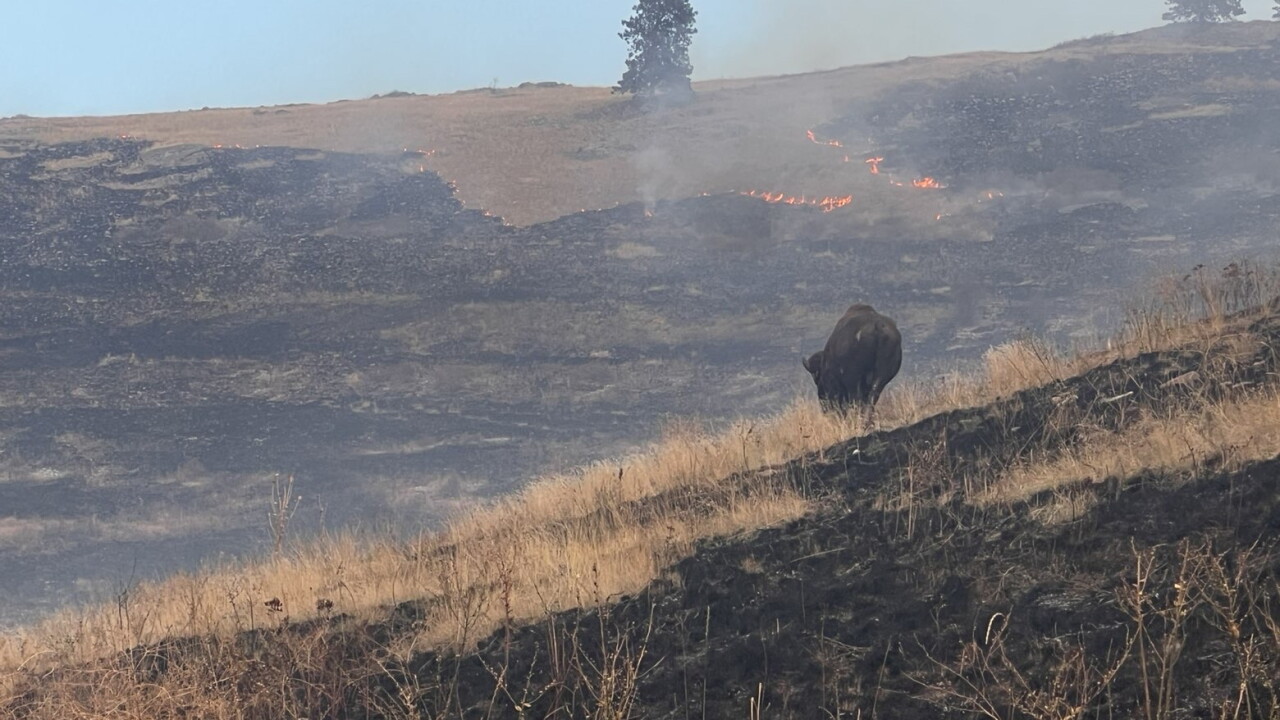


MOIESE, MT — The Confederated Salish and Kootenai Tribes conducted a prescribed burn of more than 1,800 acres at the CSKT Bison Range on Tuesday, marking the first burn at the site since the 1950s.
Fire is back at the CSKT Bison Range for the first time in 50+ years. 🔥 Here's why that matters.
Shannon Clairmont, the supervisory biologist at the CSKT Bison Range, said the burn is a major step in the tribe's effort to restore the land to its natural state following decades of ecological change.
"This is going to be pretty historic for us at the Bison Range," Clairmont said.
Since the tribe took ownership of the range in 2020, their work has focused on revitalizing the land that Native people once managed through controlled burning. The last burn at the site happened in the 1950s, when restrictions rose, and burns were no longer allowed.
Without fire, Douglas fir trees have overtaken the landscape — a species Clairmont describes as unnatural to the area.
"We got highly encroached Douglas fir pines. It is an unnatural tree in the area. This area should be a pine savanna," Clairmont said.
The area should have yellow pines spaced about 30 feet apart. Instead, Douglas fir has pushed out native plants and displaced wildlife species.
The Bison Range supports a thriving ecosystem of over 400 bison, large ungulates like elk and deer, predators, small mammals, and diverse bird populations— all affected by this ecological shift.
"Douglas fir came in and changed the whole environment," Clairmont said.
Clairmont pushed for the prescribed burn to happen for years. With help from the CSKT Division of Fire and other agencies, the burn was carried out Tuesday afternoon.
To burn more than 1,800 acres more quickly and safely, with emerging technology, the effort brought in UAS pilot Jon Davino and his team with the U.S. Forest Service.
"The drone allows a tool for us to reduce risk for firefighters and limit costs," Clairmont said.
Davino's team used specialized drones and equipment to carry out the aerial ignition.
"The ignis machine is what we use for aerial ignition. It carries spheres called dragon eggs. We can time the ignition depending on fire behavior needs," Davino said.
Clairmont said the burn took years of planning and called reaching this milestone a great feeling.
"Our main goal is to get back some of that habitat that hasn't been used by wildlife in over 100 years - bringing it back to the historical context of what it should be," Clairmont said.
This story was reported on-air by a journalist and has been converted to this platform with the assistance of AI. Our editorial team verifies all reporting on all platforms for fairness and accuracy.
