





HELENA — It’s been almost a year since the end of the 2025 Montana legislative session, but Gov. Greg Gianforte just signed the final bill from that session into law this week.
Months after the hundreds of other bills that passed through the Legislature last year had either been signed or vetoed, the lone outlier was Senate Bill 437. The bill, sponsored by Sen. Carl Glimm, R-Kila, seeks to define a person’s sex as being either male or female and fixed at birth. It’s very similar to another bill, Senate Bill 458, that Glimm sponsored in the 2023 session and that was struck down by a state district judge in Missoula in February 2025.
(Watch the video for more on what led to SB 437 sitting for so long.)
In August, four months after the session ended, SB 437 still hadn’t gone to the governor’s desk. That’s when House Speaker Rep. Brandon Ler, R-Savage, released a statement announcing he was delaying the bill on purpose, as a strategy to keep it from being blocked in court.
Before the governor receives a bill, it must be signed by both the speaker of the House and the president of the Senate. State law requires the governor to sign or veto a bill within ten days of receiving it, but there’s nothing in the legislative rules that sets a deadline for when the speaker and president must take action. In this case, Ler simply withheld his signature.
There had been no further update until this Tuesday, when, according to the Legislature’s website, Ler signed SB 437, it was transmitted to Gianforte and Gianforte signed it – all in the same day.
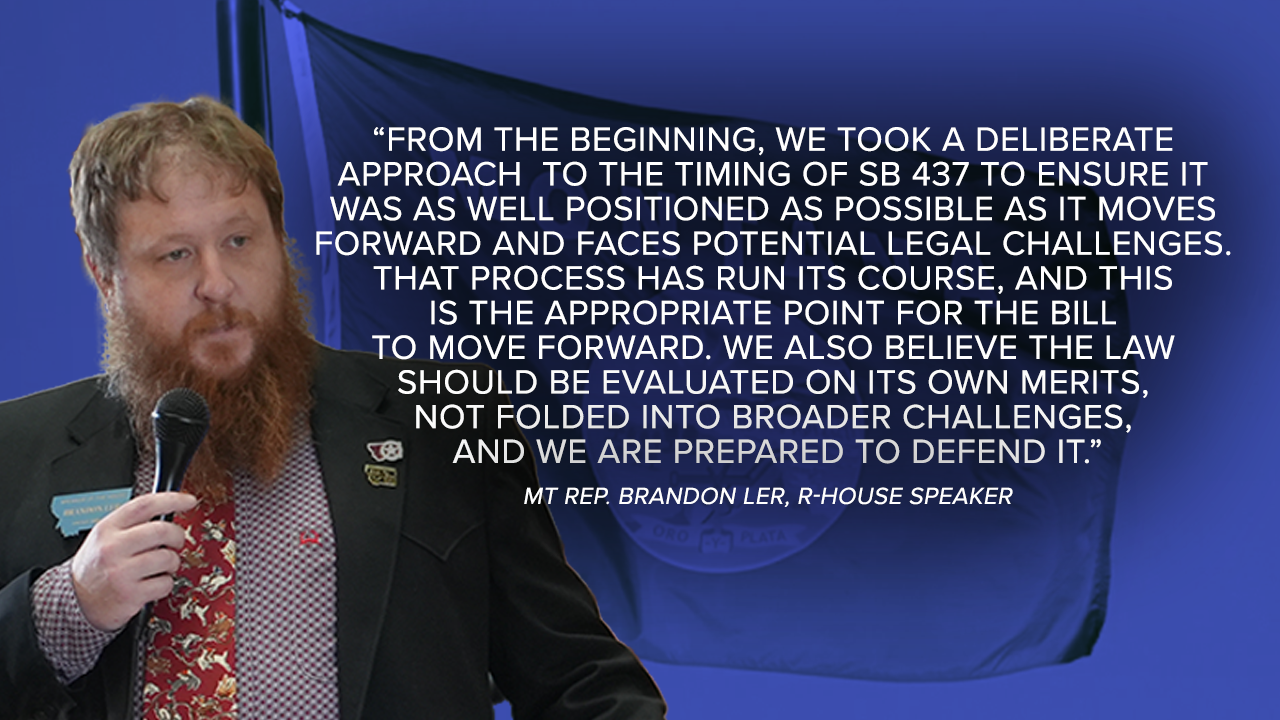
“From the beginning, we took a deliberate approach to the timing of SB 437 to ensure it was as well positioned as possible as it moves forward and faces potential legal challenges,” Ler said in a statement to MTN. “That process has run its course, and this is the appropriate point for the bill to move forward. We also believe the law should be evaluated on its own merits, not folded into broader challenges, and we are prepared to defend it.”
But Rylee Sommers-Flanagan, one of the attorneys who challenged SB 458 as discriminatory, disagrees.
“There is not a substantive difference between the laws,” she said. “There is a minor change to the way in which the definitions of a binary sex are written, and the changes in those definitions make no difference in the intent of the law, which ultimately is to create an unequal application of law to certain people.”
Sommers-Flanagan said, when the plaintiffs learned about SB 437 going through the Legislature, their case against SB 458 was still active in state district court. They told the judge in that case that they would move to expand their challenge to include SB 437 as well, once it became law. That never happened in 2025, but now that Gianforte has signed it into law, Sommers-Flanagan says they’ll make that request again.
Sommers-Flanagan says both laws are harmful to transgender and intersex Montanans, potentially weakening their protections against discrimination in the workplace, in landlord-tenant cases and in other aspects of life.
“At the end of the day, this is about rule of law,” she said. “It's not really about any of the other political sort of footballs that are being thrown around. It's just the application of the Montana Constitution equally to all people.”
While Sommers-Flanagan believes it makes the most sense to combine the cases, she said attorneys will be ready to file a separate lawsuit if the judge doesn’t grant their request.
“We would have no problem at all initiating a new lawsuit,” she said. “We're prepared in either circumstance.”
