

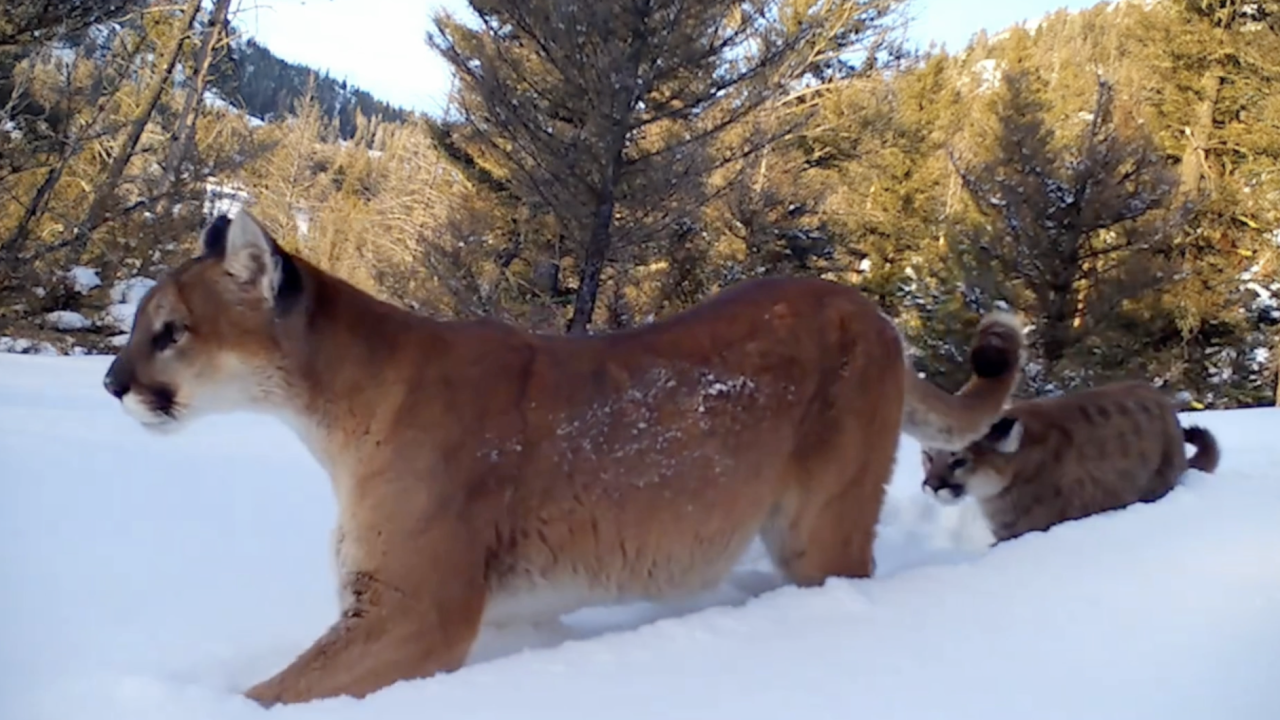


YELLOWSTONE NATIONAL PARK — Mountain lions are on the landscape here in northern Yellowstone. But they don’t howl like wolves, shun popular roads, and prefer to hunt at night. That’s why most people don't get to see them. But now, cutting technology is allowing a view of those secretive animals like never seen before.
“You know, remote camera technology has just opened up a whole new way of looking at a place like Yellowstone,” said Yellowstone biologist Dan Stahler.
On a balmy spring day, a group of park visitors, near Slough Creek, hunched over spotting scopes and stood with big binoculars in hand, watching wolves. Like most occasional park visitors, most have never seen a cougar in the park.
WATCH: Trail cameras in Yellowstone National Park reveal the secret lives of elusive mountain lions in new film
Stahler said, “With an animal like the cougar, they're so secretive, they're so mysterious, you rarely see them. This gives us an intimate glimpse into their life.”
About 140 trail cameras are now watching for cougars thanks to help from the F-Stop Foundation and Yellowstone Forever.
“We realized that we needed to tell the story of these cougars and this research, and we thought we had the footage. Wouldn't it be neat if we put it all together in a film?” said Yellowstone Forever’s Christina White.
Cougar research in the park actually started in the 1980s, before wolf reintroduction in the 1990s. But it was slow, tedious work.
Trail cameras in Yellowstone National Park reveal the secret lives of elusive mountain lions in new film
“At that time, the best tool to study cougars was to collar them. So it was a very intensive, involved fieldwork working with hound dogs that were trained to treat cougars. You could safely and effectively dart them. We still do that today, but to a lesser degree, and calling as many cougars as possible was incredibly labor-intensive. It was risky for the biologists and for the animal at times,” explained Stahler.
And that barely touches on the hours of hiking and fighting through tough backcountry that it takes to track cougars.
Stahler said while he still likes getting into the field to do research, he finds it more daunting as he gets older. He said, “Studying cougars in a place like Yellowstone in the remote backcountry is probably one of the hardest sorts of fieldwork that a biologist could embark on.”
——————————————————————————
DID YOU KNOW?
An estimated 29–45 (across all age and sex classes) on the northern range; others in the park seasonally.
Where to See
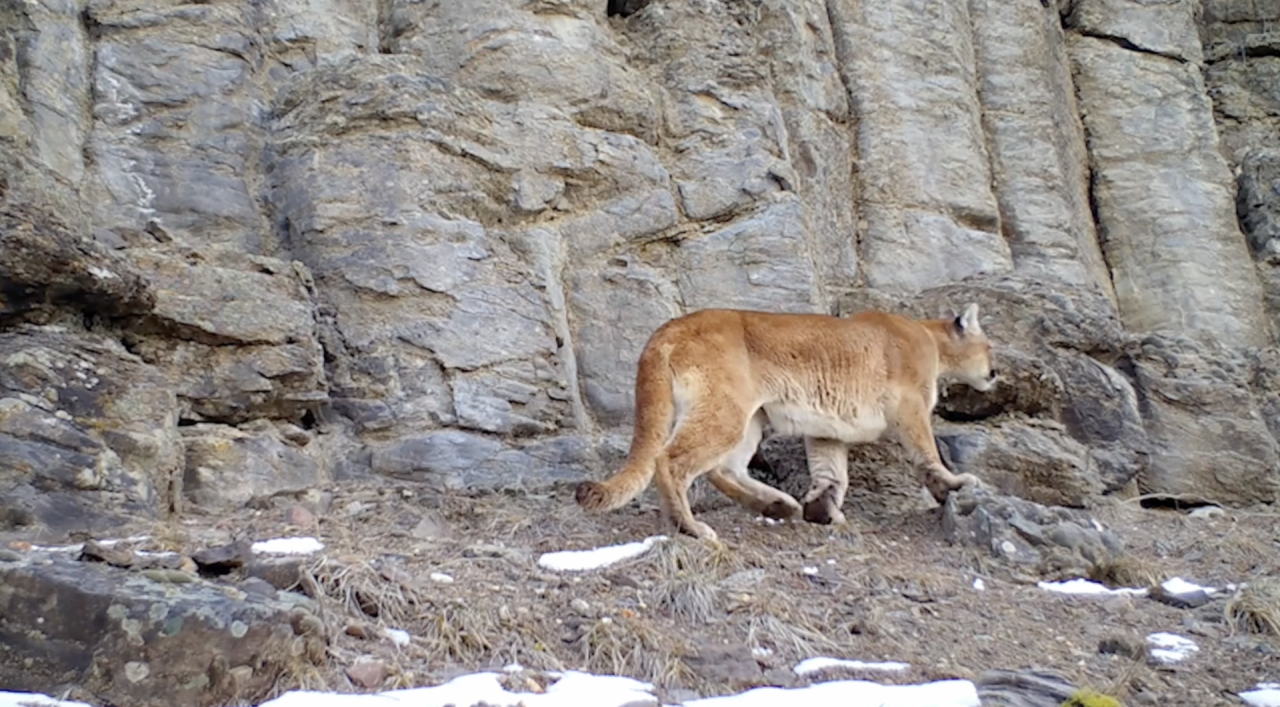
Seldom seen
Behavior and Size
- Litters range from three–four kittens; 50% survive first year.
- Adult males weigh 145–170 pounds; females weigh 85–120 pounds; length, including tail, 6.5–7.5 feet.
- Average life span: males, 8–10 years; females, 12–14 years. Cougars living in areas where they are hunted have much shorter average life spans.
- Preferred terrain: rocky breaks and forested areas that provide cover for hunting prey and for escape from competitors such as wolves and bears.
- Prey primarily on elk and mule deer, plus smaller mammals, especially marmots.
- Bears and wolves frequently displace cougars from their kills.
- Male cougars may kill other male cougars within their territory.
- Adult cougars and kittens have been killed by wolves.
Interaction with Humans
Very few documented confrontations between cougars and humans have occurred in Yellowstone.
If a big cat is close by: Stay in a group; carry small children; make noise. Do not run, do not bend down to pick up sticks. Act dominant—stare in the cat’s eyes and show your teeth while making noise.
——————————————————————————————

Now, armed with thousands of hours of video showing cougars and other park animals in a completely natural setting, a film is sharing what is being learned.
“So if you come see the film, you'll see the story of one particular cougar of nubs and her sort of trajectory through the park and her family trajectory,” said White.
Stahler added, “We kept getting wonderful images, and so we talked about, you know, the other part of my job here is to study wolves, and it's a great story to tell the story of Yellowstone wolves, but there's been a lot of documentary storytelling on Yellowstone wolves. There's been no storytelling on the Yellowstone cougars.”
VIDEO EXTRA: Dr. Dan Stahler tells how Yellowstone trail cameras reveal the secret lives of elusive cougars
White explained that the wealth of information provided by the trail cameras is leading to new insights. She said, “For instance, how does the reintroduction of wolves, for example, impact the cougar population? And so we've been able to really understand how those animals work together and how their population dynamics work.”
Stahler said, “Just the ability to see a cougar behaving naturally in the wild is really special. So it becomes the full package that we can do science, we can do storytelling, it's just a wonderful technology, and it's becoming more and more important to many studies across the world to monitor wildlife and biodiversity.”

You can see the film on Thursday, April 9th, in Livingston at the Shane Center at six pm, at the Gardiner High School on April 12th at 6 pm and at the Ellen Theater in Bozeman at 6 pm on April 15th. You can also see it anytime at Montanapbs.org.
“What people are missing is that out there on the landscape, there is a cougar, and they're very symbolic of so much of what we don't understand about places like Yellowstone, because you rarely see them. Just because you don't see them, it's a good reminder to recognize a lot of things we don't see are still really important to the formula of the beauty of this place.”
MORE ABOUT COUGARS IN YELLOWSTONE NATIONAL PARK:
The cougar (Puma concolor), also known as the mountain lion, is one of the largest cats in North America and a top predator native to Greater Yellowstone. (The jaguar, which occurs in New Mexico and Arizona, is larger.) As part of predator-removal campaigns in the early 1900s, cougars and wolves were killed throughout the lower 48 states, including national parks. Wolves (Canis lupus) were eradicated, and although cougars were largely eliminated from Yellowstone, the species survived in the West because of its cryptic nature and preference for rocky, rugged territory where the cats are difficult to track. Eventually, the survivors re-established themselves in Yellowstone in the early 1980s, possibly making their way from wilderness areas in central Idaho.

