

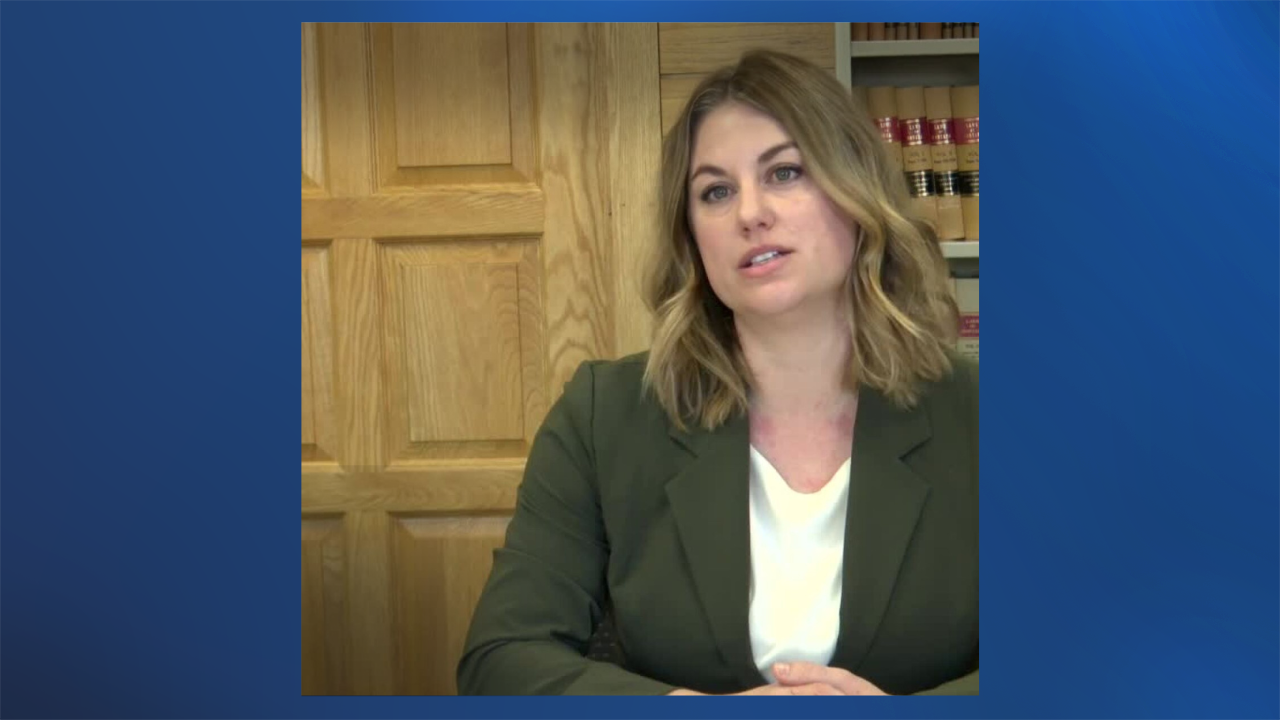

BOZEMAN — Gallatin County Attorney Audrey Cromwell is defending her office in a dispute with State Attorney General Austin Knudsen over sharing confidential criminal records with federal immigration officials.
Cromwell sent a formal reply to Knudsen today, stating that her office followed Montana law during an incident last October, when Immigration and Customs Enforcement asked for confidential records for a civil investigation.
In a press release sent out on Monday, April 27, 2026, Cromwell reiterated that this request did not involve the investigation or prosecution of criminal offenses but rather a civil investigation—a federal administrative function. “Even though ICE may be deemed a criminal justice agency under Montana law in some contexts,” she says, “last October 2025, it was acting for a civil purpose, not a criminal one.”
"Montana has long recognized a strong and independent right to privacy. Our citizens expect, and the Constitution demands, that government intrusion be limited, lawful, and justified. The improper dissemination of confidential criminal justice information for purposes not authorized by statute undermines that principle. My oath requires that I prevent such disclosures unless and until the law clearly permits them."
“This legal issue raised by the Attorney General is not about personalities or partisan politics,” Cromwell states. “It is about adherence to the rule of law, respect for constitutional rights, and the proper roles of our respective offices.”
Cromwell says her office does not have a policy against sharing information with immigration officials. She says she is simply protecting privacy rights found in the Montana Constitution.
Now, Cromwell is asking the attorney general to issue a formal legal opinion. She says state law requires him to provide written guidance to county attorneys. Cromwell says that opinion would clear up the rules for every county in the state.
In the letter, Cromwell is expecting the attorney general to issue that opinion on July 6. Until then, Cromwell says she will continue to require court orders for civil requests.
Here's the letter:
"April 27, 2026
Re: Confidential Criminal Justice Information and Civil Use by ICE
Dear Attorney General Knudsen,
I write in response to your recent correspondence regarding my April 6, 2026 request for a formal opinion. I appreciate your reply; however, it does not resolve the central legal question at issue, nor does it satisfy your statutory duty as Attorney General to provide legal guidance to county attorneys on questions of law.
At the outset, I reiterate that the following position is not grounded in policy or preference: my sole concern is to follow the law. As sworn constitutional officers, we are bound to uphold both the United States and Montana Constitutions, including Montana’s explicit and heightened right to privacy. That obligation necessarily governs how confidential criminal justice information is handled and disclosed within our state.
Under Montana law, confidential criminal justice information may not be disseminated for civil or administrative purposes absent express statutory authorization; sharing confidential criminal justice information for a civil investigation without a court order is prohibited. Your request for me to “issue a memorandum to all relevant personnel stating that Gallatin County may share Confidential Criminal Justice Information with ICE for civil immigration enforcement functions” does not address a necessary analysis under Montana law. The Montana statute governing confidential criminal justice information does not authorize disclosure based solely on the identity of the requesting entity, it also requires examination of the purpose for which the information is sought.
That distinction is critical and has been omitted from your analysis.
The request in October from the Enforcement and Removal Operations (ERO) division of ICE was not for the investigation or prosecution of criminal offenses under Montana or federal law. Rather, it was for civil immigration enforcement, which is a federal administrative function. Even though ICE may be deemed a criminal justice agency in some contexts, last October it was acting for a civil purpose, not a criminal one.
Importantly, Montana law – and the advice my office gave – does not preclude ICE or any other entity from obtaining such records. It instead requires that such requests follow the process established by the Legislature pursuant to the Montana Constitution’s sacred privacy protections.
Montana law provides a clear and consistent mechanism when any entity seeks access to confidential criminal justice information in these circumstances. A district court may easily authorize dissemination upon a written finding that the “demands of individual privacy do not clearly exceed the merits of public disclosure.” Mont. Code Ann. § 44-5-303(1). This process is routinely used by government agencies, members of the public, and media organizations.
In the discrete, case-specific instance last fall, my civil division determined that ICE should follow that same judicial process applicable to all such requests. This approach ensures judicial oversight and protects the constitutional privacy rights of Montanans. It is not a denial of access. It is adherence to the rule of Montana law. In this particular case, ICE was free to follow up at its discretion.
To assure you that my office does not have a formal or informal policy, rule, or order in this regard, I have attached an affidavit attesting to this fact under oath.
As the law is currently written, county records departments do not have the authority to unilaterally release confidential criminal justice information for civil or administrative use outside that statutory and judicial process. If the Legislature determines that such access should be granted without judicial oversight, it may amend the statute accordingly. Until that time, my duty is to apply the law as enacted.
Turning to your refusal to issue a formal opinion, I must respectfully but firmly disagree with your position. Montana law expressly contemplates that county attorneys may request opinions from the Attorney General on questions of law arising in the course of their official duties. See Mont. Code Ann. § 2-15-501(7).
For more than a century, Attorneys General in Montana have honored this duty. The published opinions of the office date back to 1899, reflecting over 125 years of continuous practice. Those opinions have long been relied upon by public officials across this State and carry the force and effect of law unless and until overturned by a court. This established practice provides uniformity, clarity, and stability in the administration of government.
Your refusal to issue an opinion in this instance departs from that longstanding tradition and leaves a significant legal question unresolved. Given the plain language of this statutory directive and the historical practice of the Attorney General’s office, I am compelled to question the basis for declining to act. The reasonable inference is that there is concern your office’s legal analysis Gallatin County Attorney Gallatin County Attorney's Office may not withstand judicial scrutiny. If that is not the case, then there is no reason to withhold an opinion that would resolve this matter definitively.
Accordingly, I reiterate my request and expectation that you fulfill your clear statutory duty and issue a formal opinion. My request was submitted on April 6, 2026. Pursuant to applicable law, I expect a response no later than Monday, July 6, 2026.
With respect to your reference to potential supervisory authority, I want to be clear and precise: I am happy to issue internal directives or memoranda to the county records department on this issue as soon as you provide a formal Attorney General opinion carrying the weight of law. If such an opinion concludes that my interpretation is incorrect, I will follow it unless or until it is overturned by the courts.
In the interim, I have instructed the county records department to direct any questions regarding this specific issue, namely the release of confidential criminal justice information under MCA 44-5 et. seq. to the Enforcement and Removal Operations (ERO) division of ICE for civil immigration enforcement or administrative purposes, directly to your office.
Finally, I return to first principles. Montana has long recognized a strong and independent right to privacy. Our citizens expect, and the Constitution demands, that government intrusion be limited, lawful, and justified. The improper dissemination of confidential criminal justice information for purposes not authorized by statute undermines that principle. My oath requires that I prevent such disclosures unless and until the law clearly permits them.
This legal issue is not about personalities or partisan politics. It is about adherence to the rule of law, respect for constitutional rights, and the proper roles of our respective offices.
I remain prepared to follow a lawful and authoritative interpretation from your office. Until then, I will continue to apply the statute as written.
I look forward to your formal opinion.
Respectfully,
Audrey Cromwell
Gallatin County Attorney"
Parts of this story were reported on-air by a journalist and have been converted to this platform with the assistance of AI. Our editorial team verifies all reporting on all platforms for fairness and accuracy.
